
Tidal Wave: CachyOS is now Bigger than Arch Linux Ever Was!
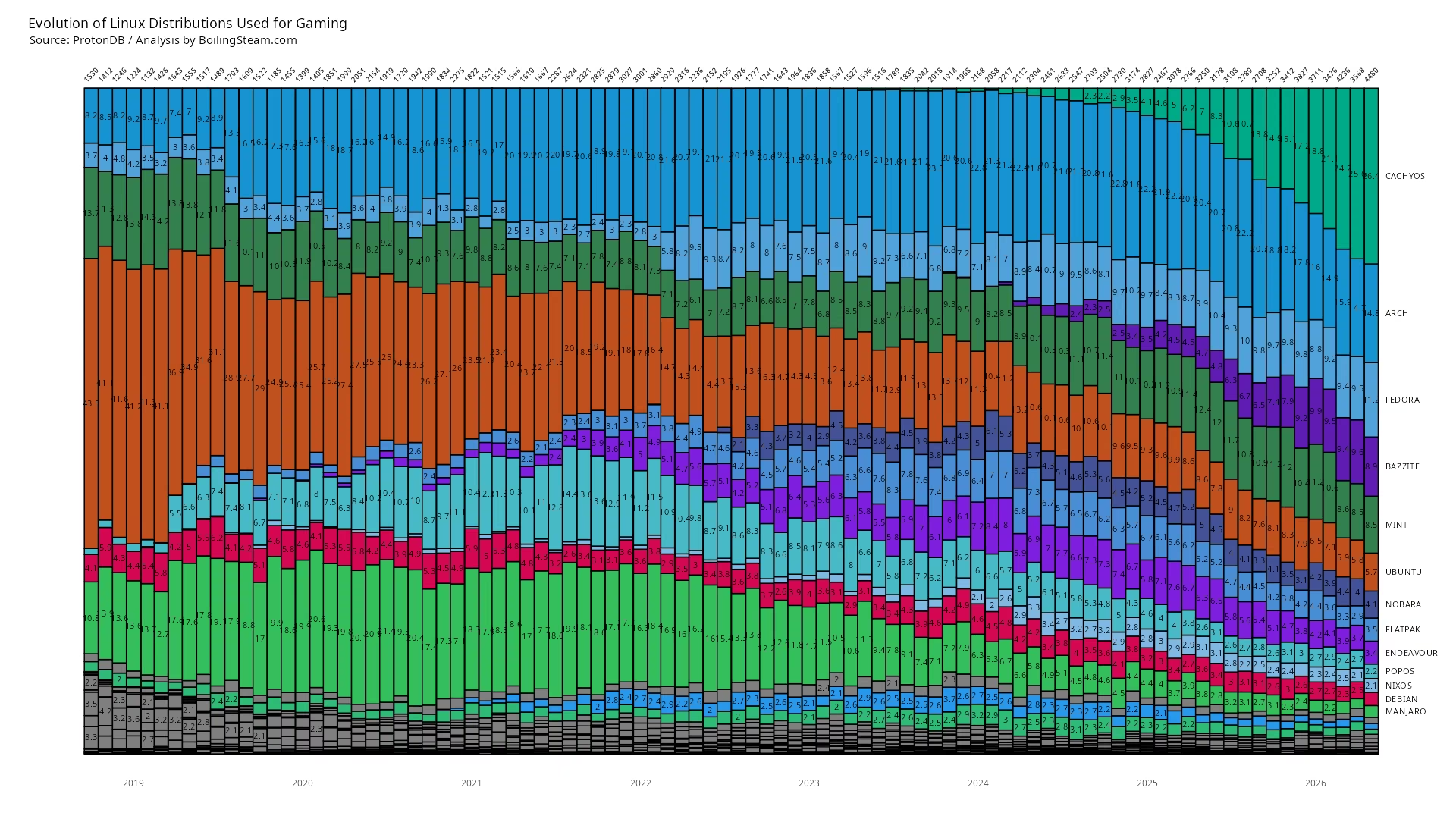
Last time we had our regular checkpoint was in march 2026 and you may recall that it was the first time that CachyOS had taken over the 1st spot on ProtonDB for desktop distros, ahead of Arch Linux. Well, taking the first spot is one thing, but CachyOS has brokend another record, by becoming now bigger in distro share on ProtonDB than Arch Linux ever was.
Before we take a look at the chart, the usual disclaimer that you love:
- This may not be representative of all types of Linux users. I’m sure this is not what your AWS architect uses on EC2, nor what you installed for your grandmother to avoid being the IT troubleshooter in your family.
- This may not be completely representative of all Linux gamers either. But I’d wage this is actually a good predictor where the market is going to shift. We saw first that Manjaro was getting the boot here first, before going under pretty much everywhere.
- There may be some additional biases, due to whoever used ProtonDB at some point in time.
- Flatpak is NOT a distro (you don’t need to tell me, I am quite aware), but that’s what Steam reports when it’s running on Flatpak, and Flatpak being distro independent we report it as a separate environment, if that makes sense. Feel free to ignore it if you wish.
- Arch Linux is Arch Linux on the desktop. The Steam Deck’s OS is reported as HoloISO, not Arch Linux, so stop trying to claim that Arch is first because of the Steam Deck! This is mainly data reported from desktop PCs, so no, SteamOS is not a thing at the moment on such machines. This may change as Valve starts providing official support beyond the Steam Deck. There are Steam Deck-only reports on ProtonDB, but we don’t use them here in this chart.
- We have no relationship whatsoever with any the devs who develop the distros mentioned in the list. Well, Podiki is actually involved with GUIX, but sadly it’s not nearly as popular as it should.
Here’s what you came for! You might want to click on the picture to enlarge it, because it’s small.
CachyOS is always in motion and keeps doing more and more to make the life of end users a little easier. Let’s look at what they have been cooking recently.
Recent CachyOS Developments
A wealth of updates
Here are some of the improvements in CachyOS released in March and April 2026:
Package Management & Desktops
- Shelly replaced Octopi. It is now the default GUI package manager across all editions.
- UKUI desktop was completely dropped from the installer selection.
- GNOME packages were cleaned up to be more modern; MangoWM with DMS shell added as a new option.
Installer & System Setup
- Permanent baseline snapshots. The system now automatically creates and retains one clean snapshot immediately after installation finishes.
- GRUB
os-proberis enabled by default for dual-boot detection. - Microcode logic fixed: the installer no longer wastes space installing both AMD/Intel microcodes; it detects hardware first.
- Desktop selector in Calamares now uses animated GIF/WebP previews (Plasma, GNOME, Niri, COSMIC).
Hardware & Performance
- NVIDIA initramfs sizes slashed. Massive reduction for laptops and dGPU configurations.
- Fingerprint readers are now auto-configured to work with
sudo. - Intel low-power mode (
intel-lpmd) is automatically detected and enabled on compatible CPUs. - VRAM management added via a native toggle (
dmemcg-booster). KDE gets the foreground booster installed by default if toggled. - Default NVMe I/O scheduler switched from
noneto Kyber for better responsiveness under mixed loads.
Networking & Privacy
- DNS-over-HTTPS built-in. The Welcome app now uses Blocky, allowing users to auto-select fastest DNS servers with latency testing and metadata display.
- Mirror rating logic overhauled specifically to fix broken experiences in China and Russia. Wireless regulatory domains are automatically set based on timezone.
Kernel & Drivers (linux-cachyos)
- Kernel workflow completely changed: moved from a monolithic single-patch system to a dedicated repository publishing tagged releases for every update.
- NVIDIA fixes applied: dropped
S01xpower management and disabledAggressiveVblankbecause they caused crashes with the 595 driver and VR headsets. Removed forced Xorg sessions on legacy 470 drivers. - AMD Plymouth theme swapped out to fix rendering glitches on laptops with secondary monitors attached.
Handheld Edition Specifics
- The base ISO was moved from X11 to Wayland.
- Replaced
gamescope-session-pluswith a Valve-forked version that actually enables firmware updates for Steam Deck and Legion Go via fwupd. - SDDM replaced by
plasma-login-manager. Limine is now the default bootloader (auto-snaps boot entries). systemd-boot remains an option. - Hardware profiles refined: added Xbox ROG Ally support, fixed false-positive MSI Claw detections on other laptops, and added Marvell Wi-Fi profile for Surface Pro 4.
Optiscaler Addition
It is not a CachyOS invention, but they have recently integrated Optiscaler directly into their custom Proton fork making it readily available to use. Proton-CachyOS is offered as a selectable runtime in their installer.
Optiscaler acts as an injection layer that intercepts calls for upscalers (like DLSS, FSR 3, XeSS) and swaps them out at runtime.
For AMD users (specifically RDNA 3/4), it allows the system to automatically inject or upgrade DLLs so games using older tech (FSR 3) can utilize newer versions like FSR 4, which should be faster and higher quality, so that you can have your cake and eat it too. Here’s a video from a few months ago explaining the benefits with games at hand.
For NVIDIA users, if a game forces FSR/XeSS for some reason, you can swap back to DLSS if the DLLs support it (though this has limitations). Probably not as useful if you are on team green.
Anyway, it’s a very cool tool, that should be now very easy to access within CachyOS, while it can be used on any distro, really.
Popularity
Of course ProtonDB is an indicator, but the tell that you made it is when there’s an infinite scroll of clickbaity videos about CachyOS on Youtube, with every influencer (lol) sticking their best Youtube faces all over the place for the world to die in a final facepalm.

Yes, sometimes winning is sad.
Other News in the Ranking
While everyone was focusing on CachyOS, there are big changes in the ranking. Ubuntu seems to be going to Manjaro way, declining month after month and soon crossing below the 5% bar. This is absolutely astonishing for a distro that was used by about 40% of ProtonDB users just 6 years ago. Ubuntu is not the only one in decline, Linux Mint which used to be stable as a rock and on a growing trend in the course of 2025, is now falling behind and list 2~3 % of share over the past few months. Nothing catastrophic, but somewhat unexpected. PopOS has no way back to recovery it seems. That’s what happens when you miss the train, or well, the momentum that you had going back in 2021, 2022. Cosmic may end up being a good desktop option going forward, but it may have killed PopOS at the same time.
Fedora based distros seem to have some better luck. Fedora itself is in a solid 3rd position now, at 11.2% share. Bazzite is very however not far behind and was bigger than Fedora in the past 2 months! Bazzite is the other success story of 2025: it’s been growing steadily, certainly not as fast as CachyOS, but that’s one of the very few that manages to garner more and more users. Nobara remains stable at about 4%.
Distro Popularity by Origin
Another way to look at this data is to aggregate the distro by origin instead of individual brands.
So we get (focusing only on the major distros, which accounts for most of the usage share anyway):
- Arch-based: 26.4 + 14.8 + 3.4 + 2.0 = 46.6 %
- Fedora-based: 8.9 + 11.2 + 4.1 = 24.2 %
- Debian-based: 8.5 + 5.7 + 2.2 + 2.0 = 18.4 %
And we can confirm Arch-based distros are absolutely crushing it when it comes to Linux gaming.
Back in March 2026, this was the situation:
- Arch-based: 42.3 %
- Debian-based: 23.3 %
- Fedora-based: 22.6 %
And there you go: the decay of Debian-based distros in popularity is right here. Now Fedora-based distros are slightly bigger than them. My prediction is that Arch-based distros have not peaked yet.
Will we see CachyOS reach 30, or even 40% share on ProtonDB down the road?