
Did Nintendo Kill Switch Emulation? The State of Yuzu, Ryujinx, and Their Forks in 2026
We have been covering the Nintendo Switch emulation for years, because it’s a cool topic on the technical side, and has interesting legal ramifications as well. Emulation has pretty much always been considered legal as long as it’s done in a clean room fashion, but that did not prevent the two main Nintendo Switch emulators, Yuzu and Ryujinx, to be struck down one after the other by legal threats from Nintendo. Nintendo is an evil company who ignores any notion of fair use and systematically attacks even small fan projects. So my advice is always, don’t give them your fucking money.

Today, it’s time to see if the takedowns from Nintendo on Switch emulators have proven to be effective in the end. It’s now been two years since both Yuzu and Ryujinx have officially closed shop. But those are FOSS projects in the first place. There is a saying that good FOSS never dies, it just hibernates until someone else picks it up. So did they ultimately survive in any shape or form?
The First takedowns
On February 26, 2024, Nintendo sued Tropic Haze LLC and developer Bunnei in Rhode Island federal court over the emulator Yuzu, alleging copyright infringement and circumvention of Switch protections according to Polygon’s coverage. The case settled within a week. Tropic Haze agreed to pay $2.4 million, hand over the Yuzu domain, stop all distribution and marketing of the emulator, and destroy copies of it as documented in court filings. Bunnei confirmed on Discord that Yuzu’s code repositories, Patreon accounts, and support channels would go offline immediately. The shutdown also took down Citra, the 3DS emulator supported by the same team, as collateral damage.
Ryujinx followed seven months later under a different mechanism. On October 1, 2024, developer riperiperi reported on the project’s Discord that lead developer gdkchan that we interviewed previously had been contacted by Nintendo and offered an agreement to stop working on the project and remove all related assets he controlled. The GitHub organization was removed, download links died, and development ceased without a public lawsuit against Ryujinx itself. Work on an Android port, an iOS tech demo, and local multiplayer with real Switch hardware all stopped. At shutdown, Ryujinx had been tested on roughly 4,300 titles with about 3,550 considered playable.
The Forks Fight to Survive
In the Yuzu suit and in later takedown waves, Nintendo’s current DMCA strategy has been focusing on the circumvention of Switch’s technological protection measures. In its notices, Nintendo argues that Switch emulators necessarily circumvent those protections by using cryptographic keys to decrypt games. Nintendo argued that making decryption possible circumvents a protection under DMCA section 1201. No court has ever ruled an emulator itself illegal in the US, with clean-room emulation protected by older precedents such as Sony v. Connectix where the BIOS of the original Playstation was reverse-engineered to make emulation possible.
Sony Computer Entertainment v. Connectix Corporation, 203 F.3d 596 (2000), commonly referred to as simply Sony v. Connectix, is a decision by the Ninth Circuit Court of Appeals which ruled that the copying of a copyrighted BIOS software during the development of an emulator software does not constitute copyright infringement, but is covered by fair use.
So Nintendo is not going against the emulator angle in itself, as it could be counter-productive.
The Yuzu case ended in a settlement and permanent injunction, with the judgment incorporating findings specific to Yuzu‘s circumvention of Nintendo’s technological protections.
The attack path chosen is why GitHub takedowns have been working. Nintendo filed several DMCA takedowns in this year on many Switch emulator repositories on GitHub. Eden is the clearest case study: it filed a formal DMCA counter-notice arguing only its releases page was targeted and that it never hosted Nintendo keys, but GitHub disabled the repository anyway without engaging with the claim.
The project survived because it had already mirrored its code to a self-hosted infrastructure. Its developers then declared that their own git server at git.eden-emu.dev would be the exclusive distribution channel for official builds going forward.
The scene-wide lesson was to stop depending on GitHub entirely. By mid-2026, the surviving projects distribute through self-hosted git servers, project sites, and mirrors instead of centralized repositories. So a takedown may sweep hundreds of repos on mainstream platforms, but repositories hosted in more exotic ways continue to exist (while their access is not always stable).
How did each Lineage fare?
The Yuzu Lineage: Eden, Citron, and Suyu’s End
Eden remains active as of mid-to-late 2026, shipping weekly builds from its self-hosted git infrastructure after leaving GitHub in March 2026. It is considered the top pick for Android among current emulators.
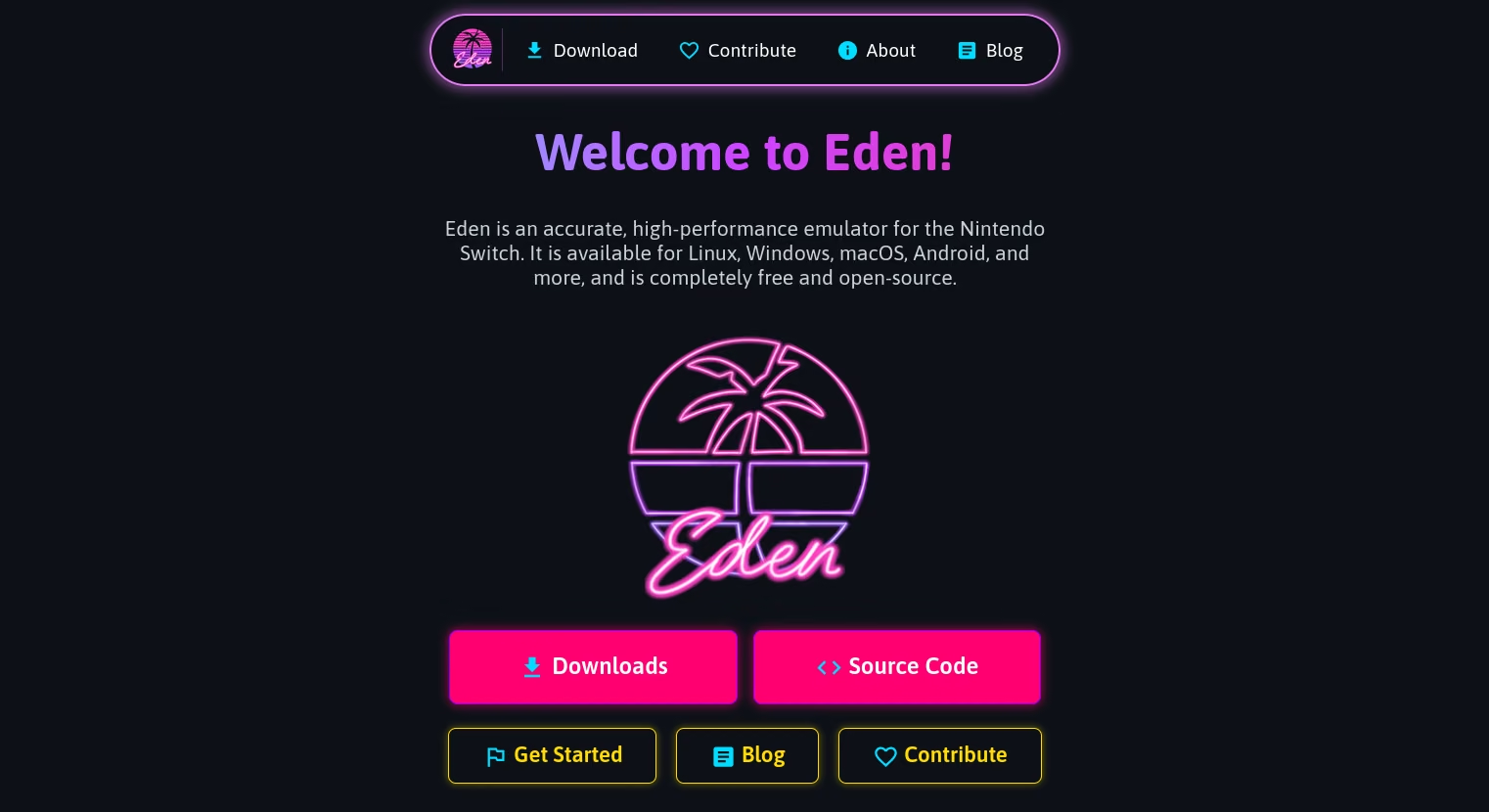
Citron, also descended from Yuzu code, kept shipping through the same period: its official release page listed a 0.12.25 stable build tagged December 26, 2025 with dozens of commits landing on main by early 2026. Citron‘s git services were temporarily disrupted in August 2026 before being restored - a typical bit of pressure put on such projects nowadays. Citron‘s repo on Github does not seem to exist anyone but there’s a citron-neo fork that’s probably just waiting for the next takedown. At the time of writing it is still alive. By the way check out their website, it’s very cute and unusual.
Suyu is the newest casualty. The suyu-emu GitHub organization was marked archived by an administrator on September 13, 2026 with a notice that the project is no longer maintained. The timing was notable because Suyu’s final v0.0.4 build had just introduced a static AArch64-to-x86-64 recompilation system. This was an important step to convert Switch game code ahead of runtime to x86_64 code for a performance closer to native speeds. Suyu had already been a DMCA target before: Nintendo took down its GitLab hosting and later its official Discord server in 2024, after which it lived on self-hosted servers.
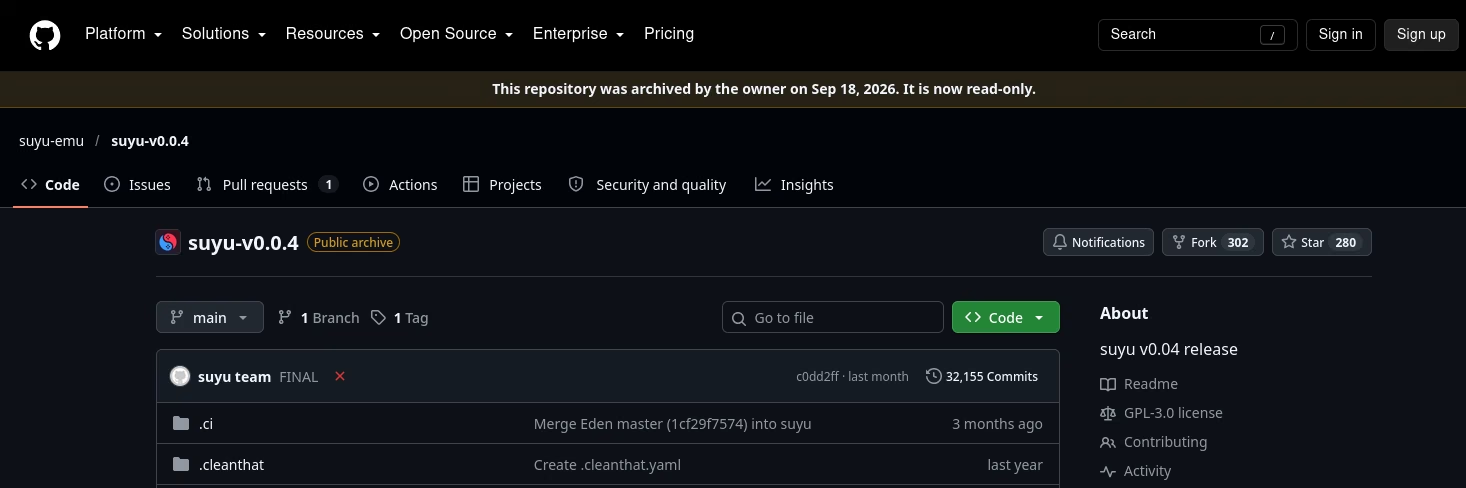
The seems to be some new work going on drippu which is the experimental branch of Suyu, while it’s unclear if it’s going anywhere for now. It’s getting quite a lot of activity at the time of writing. And there’s a fork from the previous Suyu repo as Suyu-main which is still somewhat active.
So far, the Yuzu lineage has been faring OK. Always attacked, but still available in one fork or another.
The Ryujinx Lineage: Ryubing and Kenji-NX
The original Ryujinx project has been frozen since October 2024, so anyone installing a “Ryujinx” today is really installing a fork of that codebase. The most active successor is Ryubing, which ships rolling releases through 2026 from a self-hosted domain plus mirrors rather than a single GitHub repository, a distribution choice that looks deliberately designed to reduce single-point takedown risk. Community testing in mid-2026 had it running roughly 75% of games. It seems to be difficult to download it right now, but it might be a temporary problem. There is also a flatpak available, but that’s already one year old.
Kenji-NX is another actively updated fork in this lineage, with optimizations targeted at newer mobile silicon such as the Snapdragon 8 Elite. The site still exists but the downloads have been disabled so in effect it’s becoming very hard to access it. Unless it finds a way to survive, this may well be the end of thits one too.
So far it looks like that Ryujinx lineage may be less robust in terms of availability, at least. And this means development may have stalled, as well.
What Died Along the Way
Many forks have already disappeared. Sudachi, one of the oldest Yuzu forks and a reliability favorite while it ran, stopped development in August 2025. Its solo developer Jarrod Norwell said on the project’s website that Sudachi was no longer in development due to his commitment to Folium, a commercial iOS multi-emulator app. His final release shipped July 2, 2025 per Android Authority. Norwell had earlier cited what he called a very unsafe and unpleasant environment around Switch emulation as the reason for winding down, and he now contributes to Eden instead. Other forks such as Skyline and Pomelo were already dormant before the 2026 sweep even landed.
The pattern mirrors what Nintendo did to 3DS emulation a year earlier, when Citra’s shutdown produced fork projects like Azahar and Lime3DS that kept the codebase alive. The enforcement strategy is repeatable: target the highest-profile project with litigation or a coordinated takedown, let the settlement create a chilling effect, then use routine DMCA notices to keep pressure on whatever forks emerge afterward.
Switch Emulation: Dead or Alive?
We need to look at three aspects:
- Are the original projects gone for good?
- Did Switch emulators stop existing after the legal action?
- Are the remaining projects still actively developed?
Availability of original projects
When it comes to the availability of the original projects, Nintendo’s takedown has proven very effective. Yuzu’s official distribution was destroyed by contract in March 2024 and has not returned. Ryujinx’s GitHub organization is gone, its download page dead, and no official builds are published under that name anymore. Repeated takedown waves in 2026 removed the bulk of remaining mirror repositories, including 311 Suyu-related repos gone in a single August sweep.
So: yes, the ongoing DMCA strikes have been VERY effective to keep the originals and the direct copies from spreading around.
Recent Switch Emulators
But if we look at the availability of working Switch emulators as a category, this action has been largely ineffective. As of October 2026, at least four projects (Eden, Suyu-main, Drippu, and Citron-Neo) that are actively or still somewhat available through self-hosted channels where GitHub DMCA notices have less reach. The cost to users is discoverability rather than access. But they are available.
So, Nintendo’s actions have not completely managed to shut down the availability of Switch emulation, as long as you know where to look.
Slowing down or stopping development?
On stopping or slowing down development, the takedowns have had some success. There is no arguing that the Switch Emulation scene is not merely as popular as it was a few years ago. There was a LOT of money involved at the time, which in turn helped development accelerate. The fact that 2 emulators were in competition made things go even faster. Now, with the main projects gone, the forks being constantly chased, and the risks involved with any kind of project in that area, it’s not rare to see forks stopping development all of a sudden or giving up.
Despite the ongoing purge on Github. Eden is one of the most active ones left, and is alive and well today with commits almost every day:
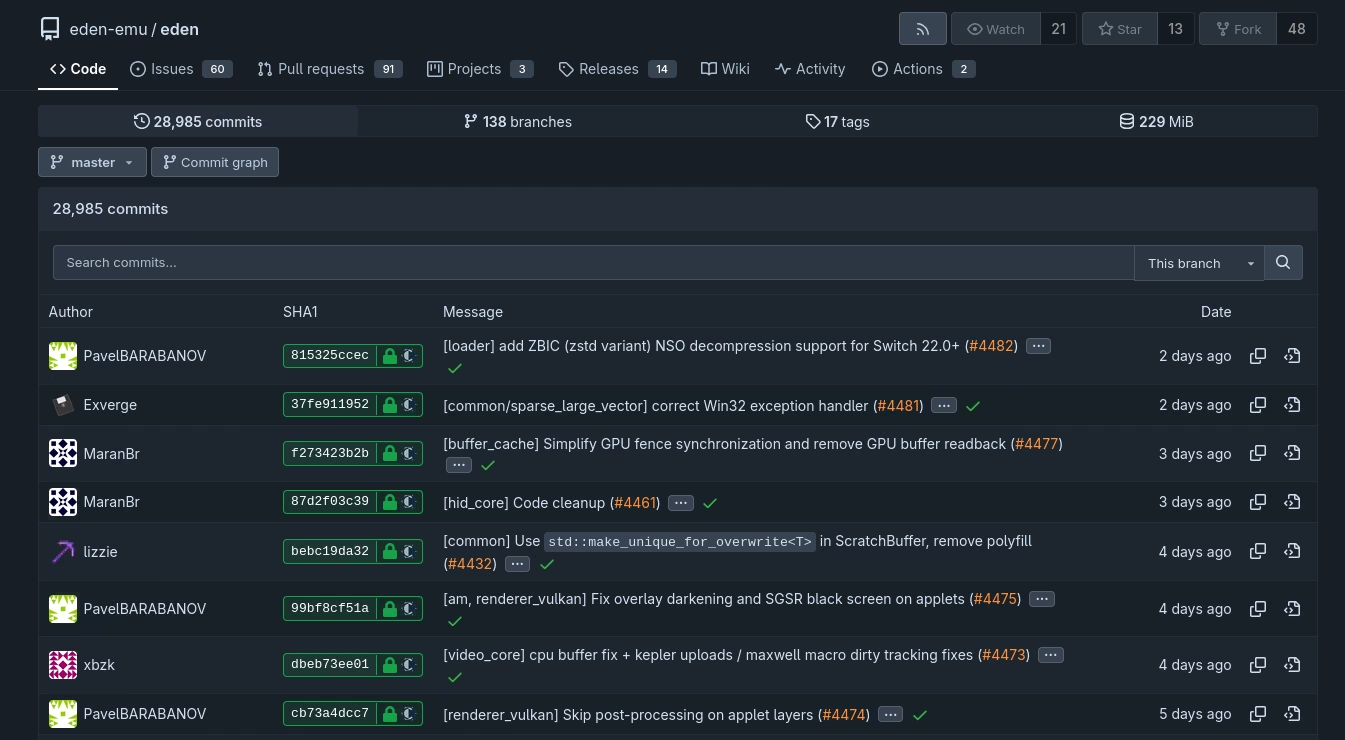
I just tested of the latest AppImages for Linux and it works as expected.
But let’s be real. It has become mostly a volunteer / fan effort. In that sense, Nintendo was successful to discourage at large such projects. They can’t kill the whole scene, but if they manage to add friction in every single cog of the system, they will do it and enjoy seeing people struggle.
But the underlying open-source code and technical knowledge remains out there, so it’s just about the willingness of picking it up.
The path forward
Most forks stop after a while, change hands, become forked themselves. So this is in effect a much more chaotic environment than before 2024. The Switch emulation scene in itself remains alive, but it looks more like survival despite the constant attacks.
There are valuable lessons from what happened here, well summarized by Eden’s team.
- Don’t paint a target on your back by using large platforms that are easy to DMCA like Github and Gitlab
- Making money with your emulator in a very obvious way will also attract unwanted attention
- Plan for mirrors, decentralized communication, decentralized repositories if you want to make it harder to be shut down. This is a key concern from the get go. Once your code is in the open there is a good chance that it will keep living on even if you stop working on it, as long as it’s available somewhere.
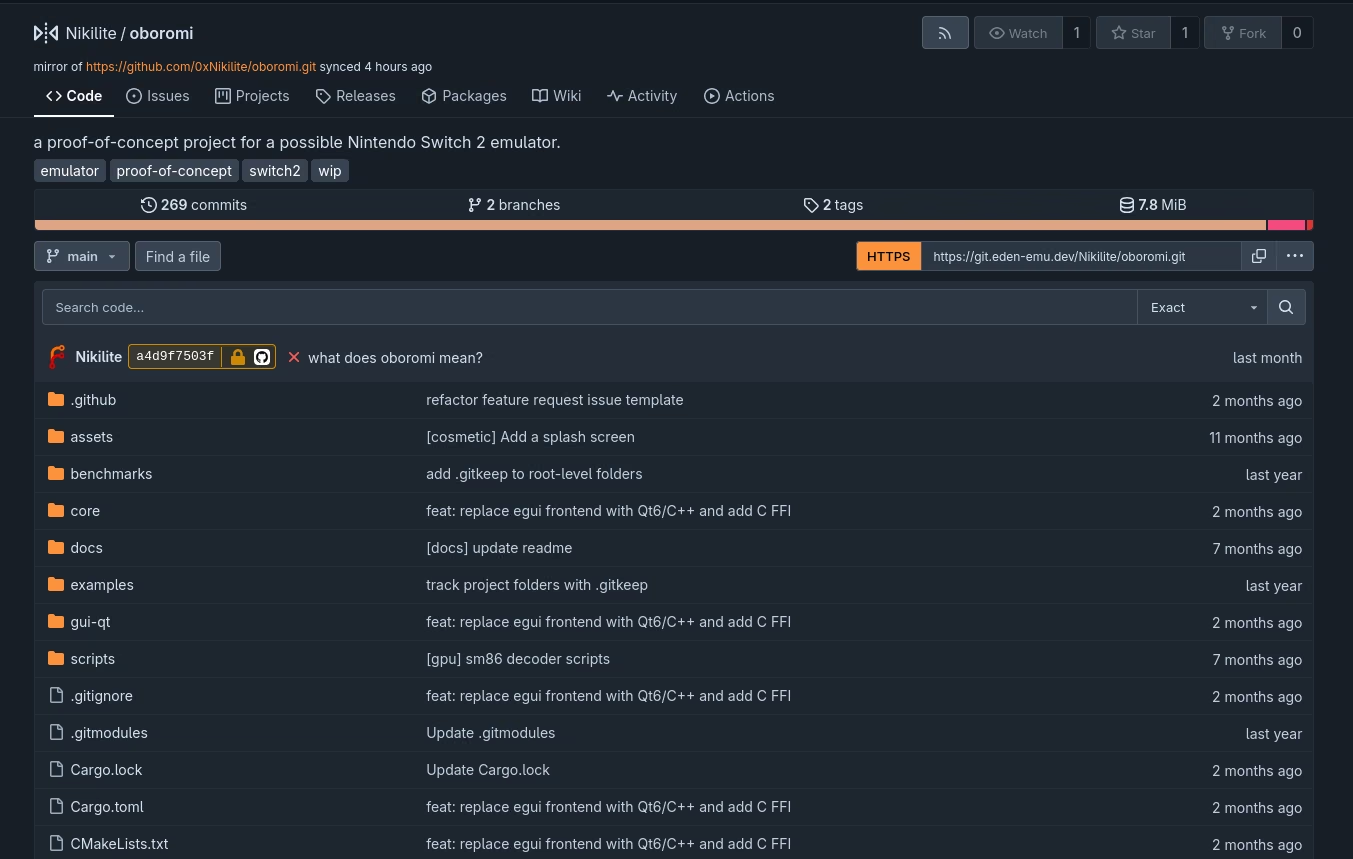
You can see that is something that early Switch 2 emulators are doing, like oboromi which has both a Github and a Forgejo instance.
But there is a game changer on the horizon. With the popularity and availability of frontier AI models, many technical problems that used to be really challenging to solve are about to become really shallow. There is no way that emulation is not going to benefit from that. Now very few devs armed with coding agents and strong models should be able to advance much faster, even on a limited and decentralized infrastructure.
The game of cat and mouse can therefore continue.
Backup your emulator copies, just in case.