
I get to rule Lisbon in Crown of Hispania: Review on Linux and Steam Deck
My full title for this review was: “I accidentally married my heir to the youngest daughter of the Badajoz’s king and now I get to rule Lisbon.”
I always wanted to title something like those Korean novels. Now I can remove that from my bucket list thanks to Crown of Hispania, a simplified grand strategy game by Regalis Studio published by indie.io that focuses on the Iberian Peninsula. It works on Linux and Steam Deck with Proton.
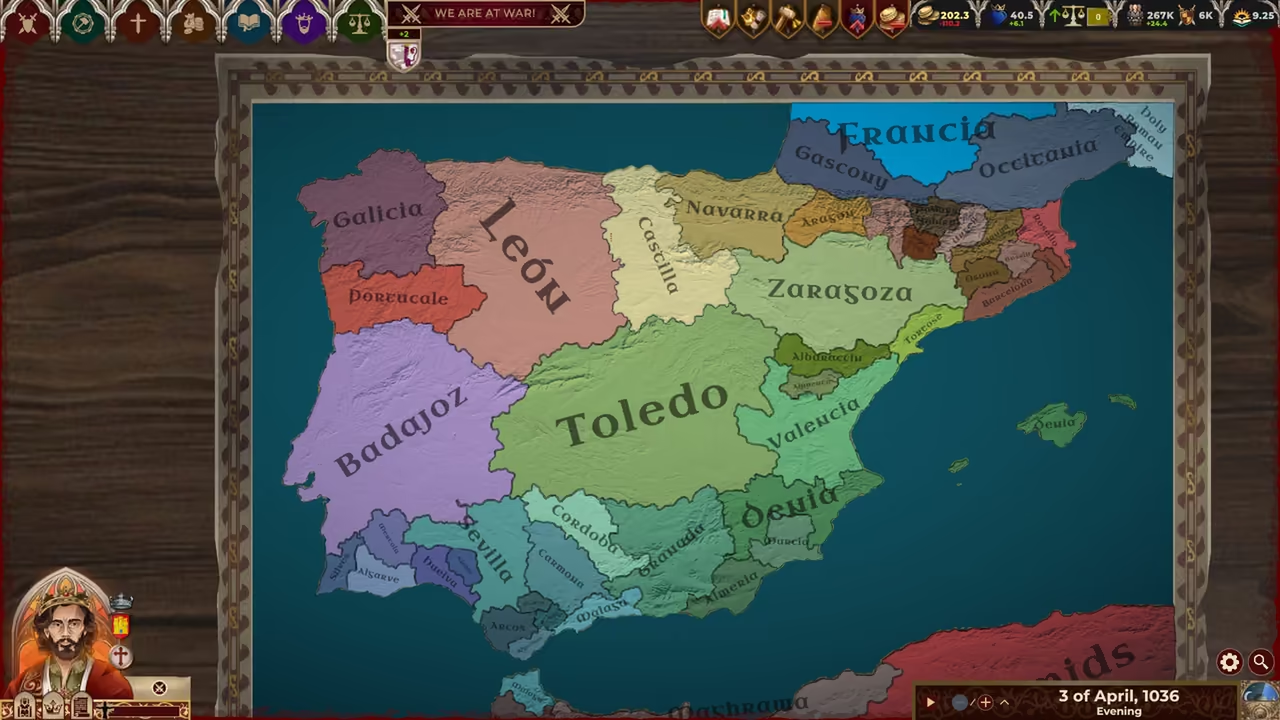
Calling it simplified is a disservice. For two reasons. One, if you are coming from Paradox games, like Europa Universalis, the game at first glance might seem to be offering less, in terms of size and options of things to do, but Crown of Hispania has some depth. Second, it is not as simple as it could be, because in its current state it is hard to find the things you want to do within the menus (and I hope they improve this).
The scope of the game is the Iberian Peninsula starting in the earlier 1000s, long after the Moors conquered the land, right when the Christians realized they do not like a heterogenous land and started pushing away people from the land. The game starts with a balance that anyone can take power, but events might favor the people that knows their story well.
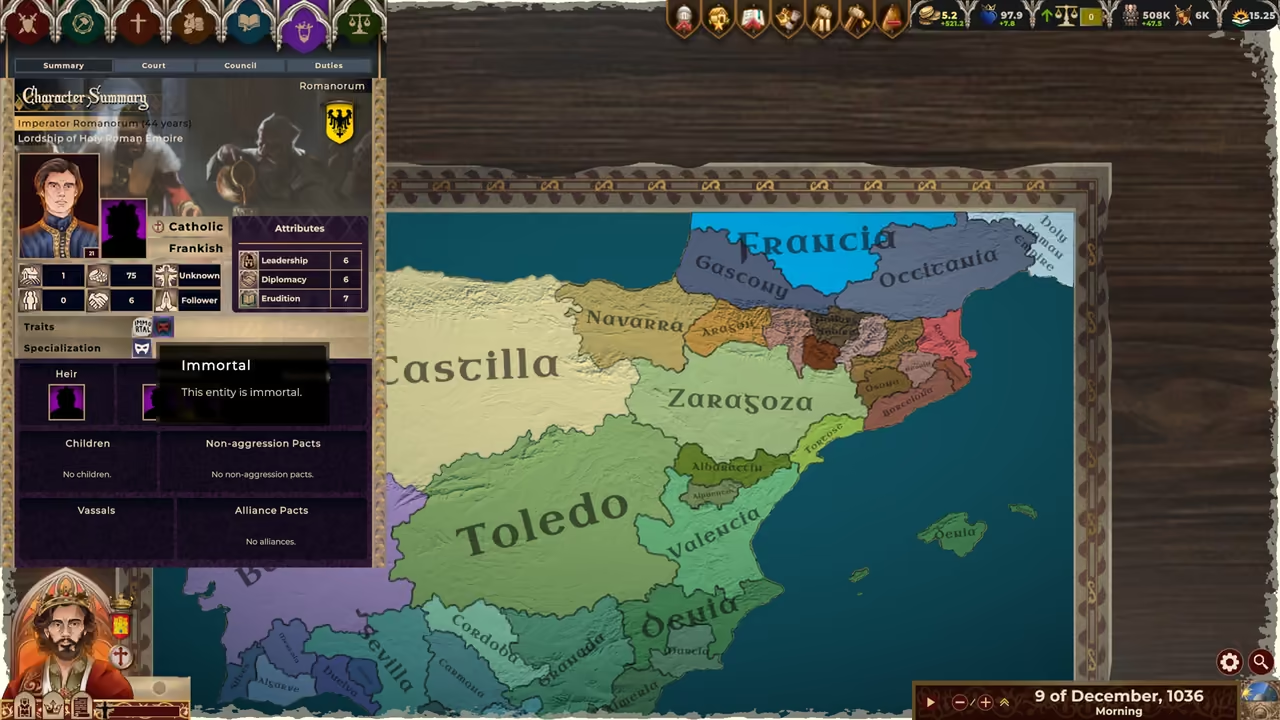
I used to have just a superficial knowledge of the period until I met a French student during my university days who gave me a lecture on the events and the inbreed royals (to some extent a pleonasm) of the time. Well, I thought it’s relevant to bring that up because I imagine a French studio will do a good job with historic accuracy.
Also, don’t be fooled by the geographic scope seemingly smaller than other grand strategy games: areas are finely divided in provinces and each province has two aspects to manage, the urban centre and the countryside. You manage them by issuing policies, like stimulating migration from the countryside to urban centers (or vice versa), and building infrastructure: farms, workshops, churches, each providing different boosts for your provinces. Now, I hope it is a bug or else it means that I am awful at the game: I would get some warnings that a province was starving, and while I spent decades investing in farms, irrigation, and forcing the urban population to move into farms, I could barely make a dent in food scarcity. Maybe those provinces were destined to starve?!?
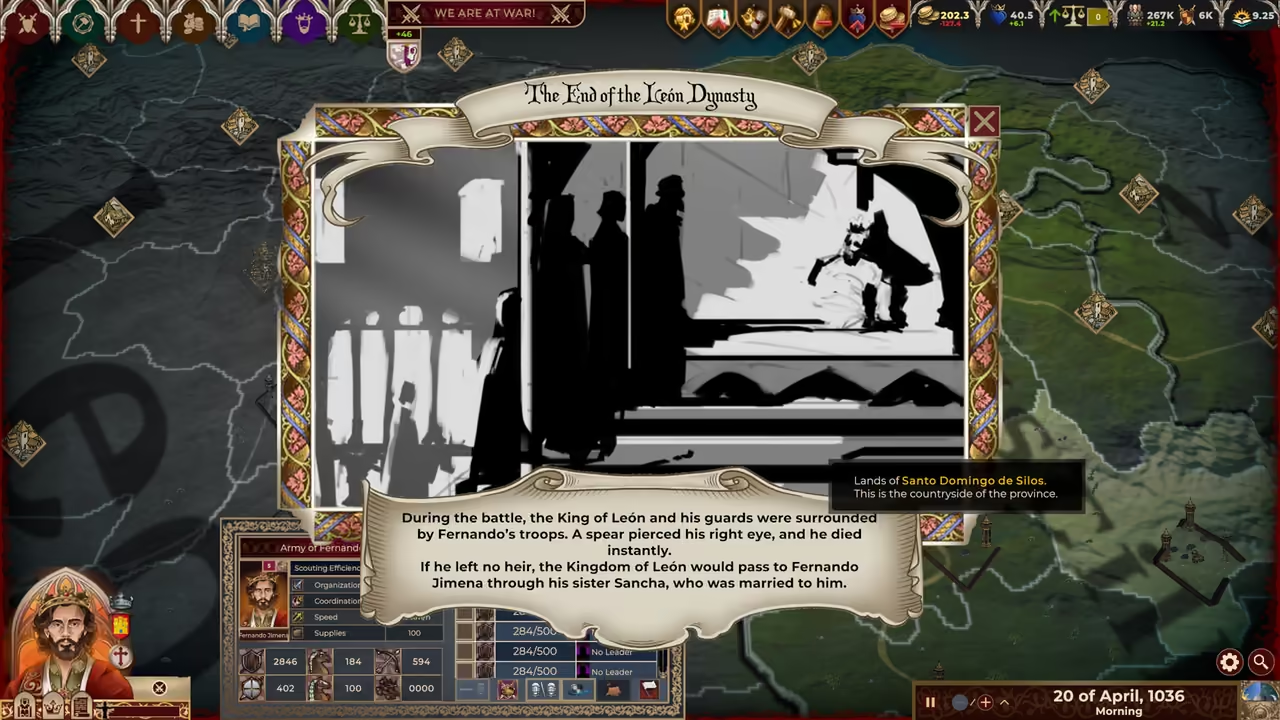
My first run started with the tutorial, I got hard locked and had to start again. Next time, it worked, but I digress. The current tutorial is a bit shallow and don’t cover a lot of things. You will have to discover by clicking around and experimenting. Concluding the tutorial puts you in the main game in easy mode: you start with Castile. Castile is one of the large Kingdoms in the land, deserved by a great location and with plenty of resources. Right out of the bat, your mighty neighbor declares war. You raise an army ten thousands strong, their king dives neck first on the first sword it sees in the battle and, because you are related, now you become the king of Castile & Leon, a powerhouse that no one can match. Neighbors start flooding your DMs with non-aggression pacts. Here was the first time I could not find how to do what I wanted to do (saving the starving folks came later): How can I actually do counteroffer?!?
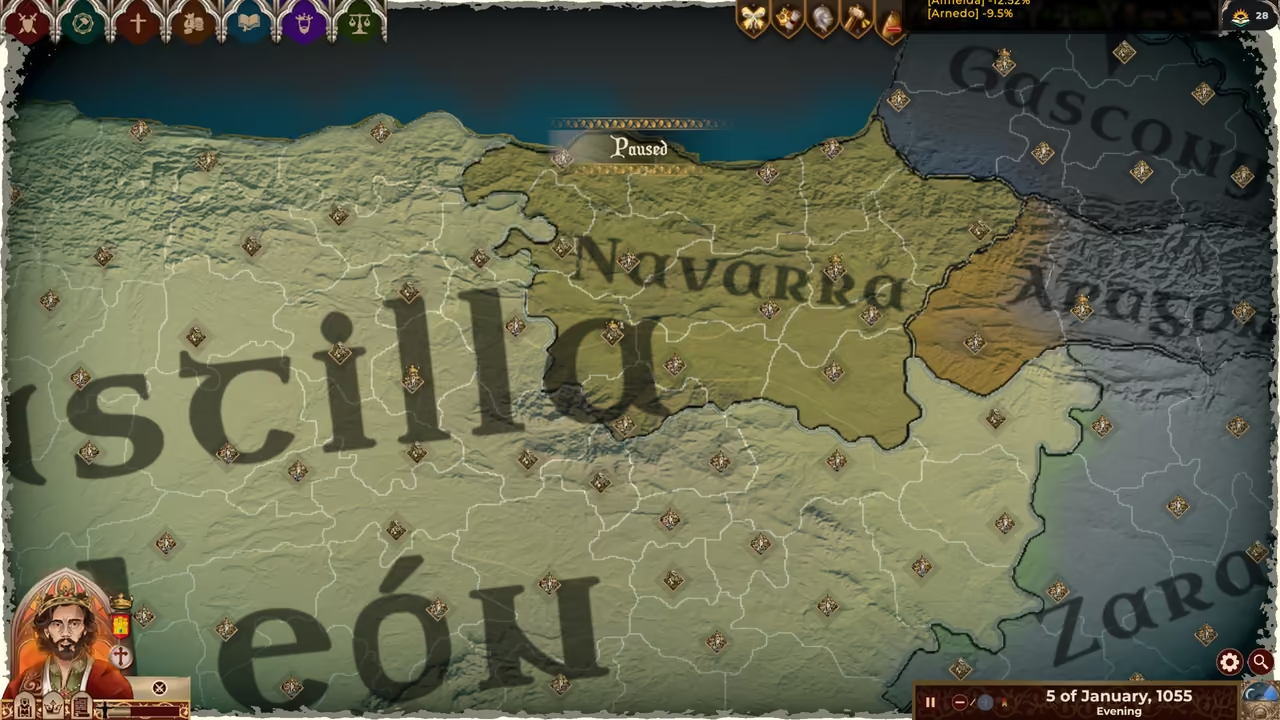
Listen, if I had the short stick, everyone would be waltzing their spears on my territory, demanding tributes and my firstborn. At least is what you expect on a grand strategy game. But apparently not here. There was no way to bundle up diplomatic proposals or sweeten deals. Even worse, it was not clear what are the conditions to some interactions. Sometimes I would not see an option there, sometimes the option would appear, but it would be blue and not selectable. Sometimes I could see trade agreements even with people that hate my guts.
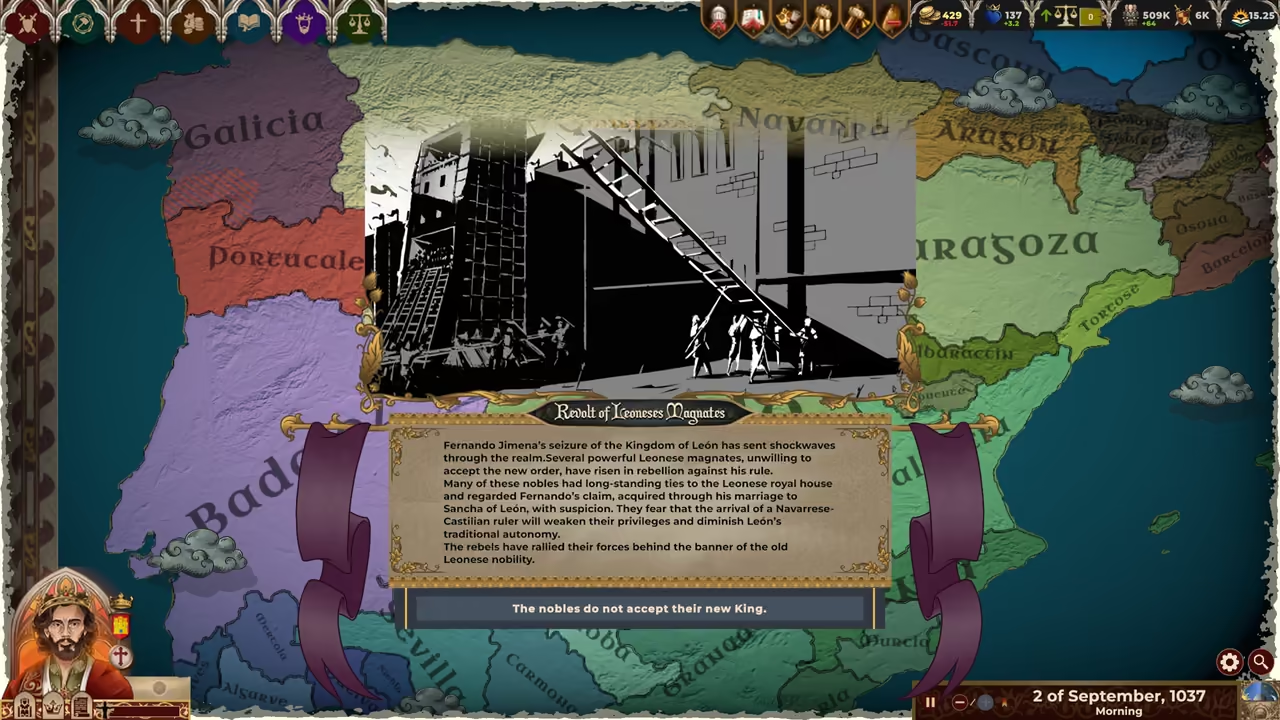
While everything was easy and breezy with Castile, I had to try my hand on other civilizations a bit out of focus from the central powers. Starting with a smaller place and of a different religion, but not so small and weak that it would be mostly harmless. Enter the Maghrawa, a Berber confederacy located at the north edge of Africa. You might think I had a strategic decision because they have a bit more land that other single provinces’ leaders, but no, it was for the sole reason that their flag looks cool, and I like that shade of green.
For a number of reasons, it was weaker than Castile. If I got an army it barely reached a thousand recruits without forcing people into conscription. Almost every land was starving with low to no growth. The court population was very small, with many empty slots that were impossible to fill. For bad or for worse, there were no big events related to that civilization, safe from religious holidays and minor things (it seems devs are planing for more events). On the bright side, having no events nor a strong army forced me to engage in other activities. It was fun to discover everything, but on another hand it was frustrating when things would not make sense or get me into some bug or game lock.
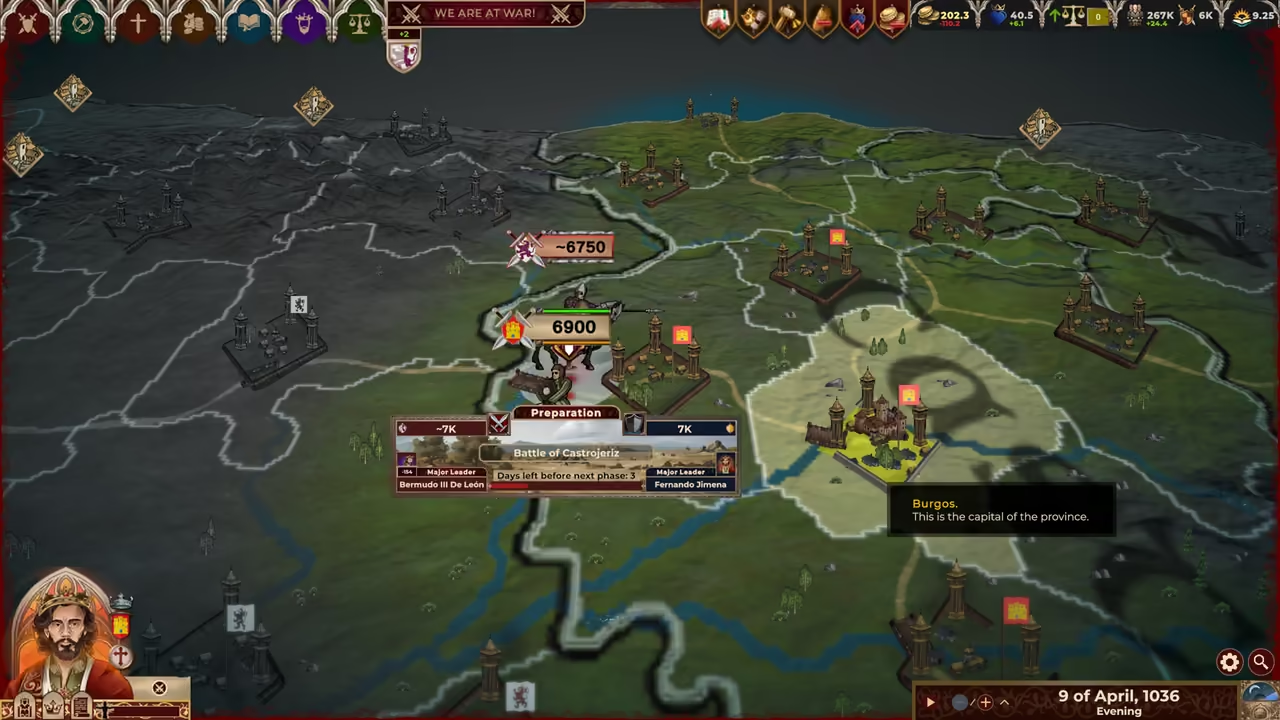
The workaround for most of them was to reload the game a point earlier and do different things, which was frustrating. I don’t have (anymore) the habit of saving constantly and sometimes I would lose a year worth of decisions. Some problems were hardcoded, like when I learned I could not conquer an European province from Africa, I even conquered the whole (available) Africa and there was no way to request European lands through war. Hopefully a bug that gets fixed.
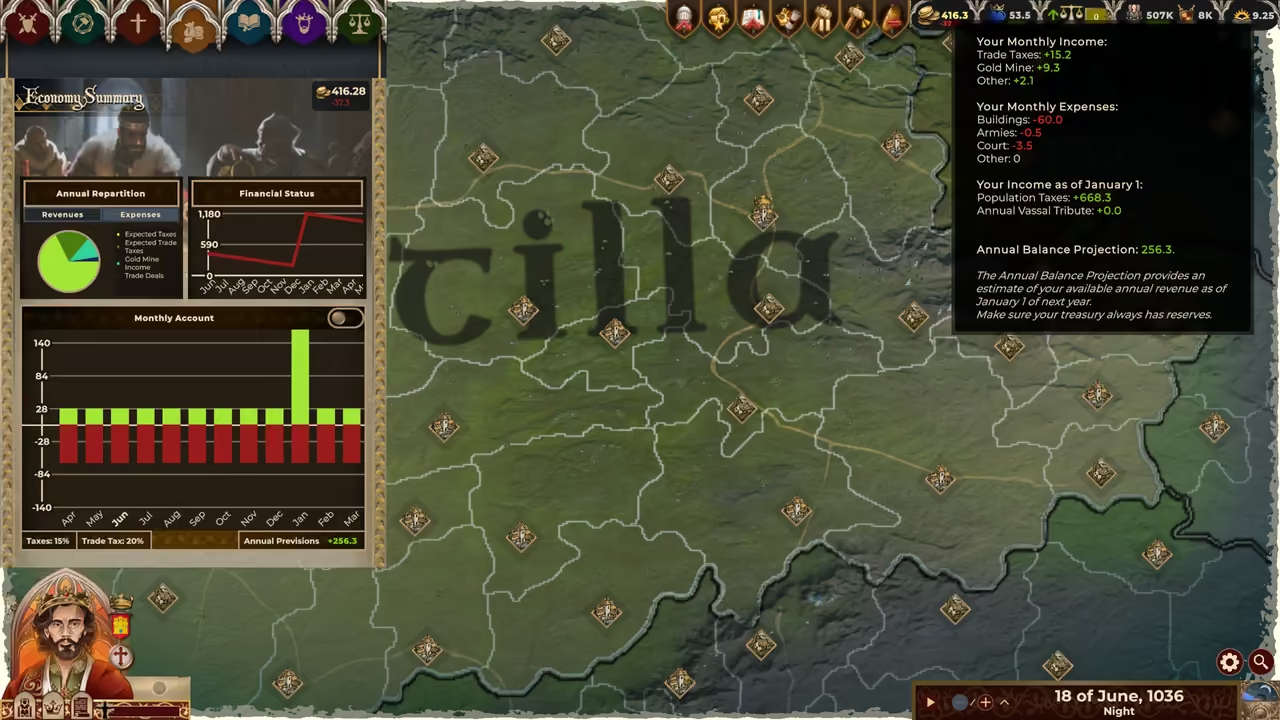
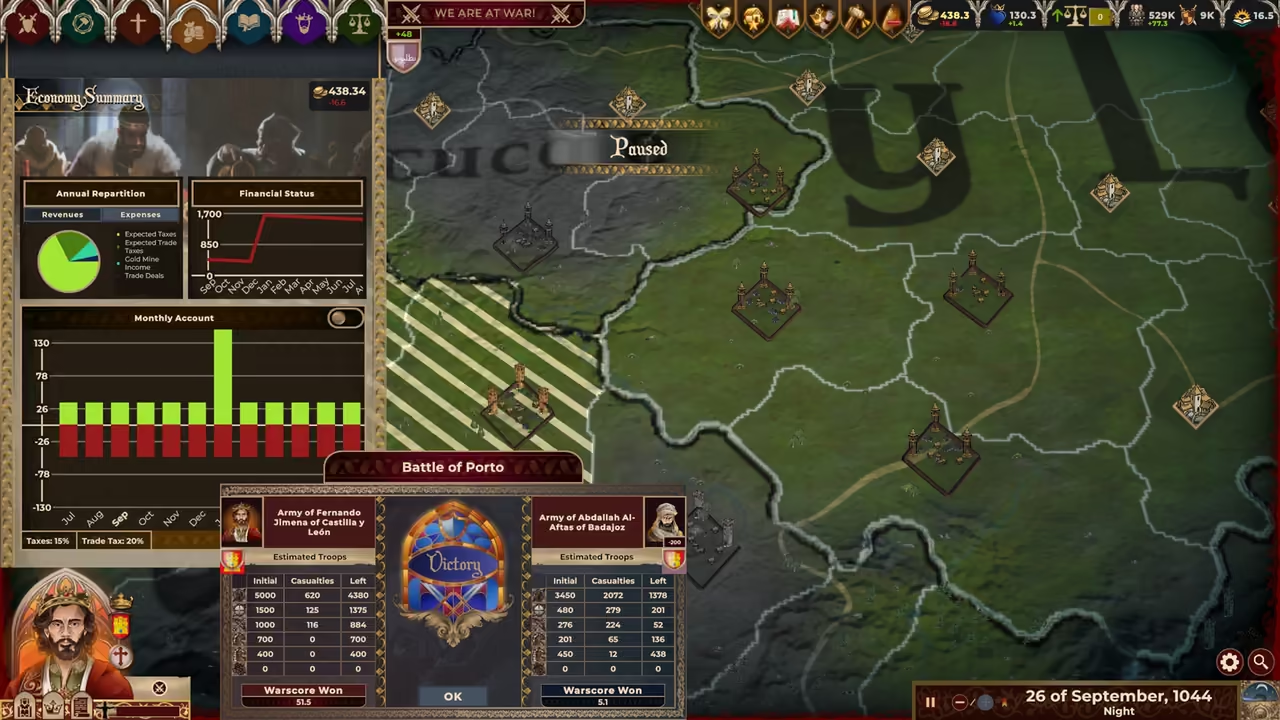
Most of the time, just like with Castile, I would just be looking at the money menu, where you have a huge influx of gold in January from taxes, and smaller ones from trade every month. Constructions are not paid in full, but in equal installments every month (a la CAPEX). So you need to balance your cashflow as to never hit 0 gold, or all your constructions will be paused. For that you can pause single constructions for immediate effect, or build business and pass policies to increase revenue in the long term. It is also wise to have some spare gold for emergencies (mostly paying for religious holidays).
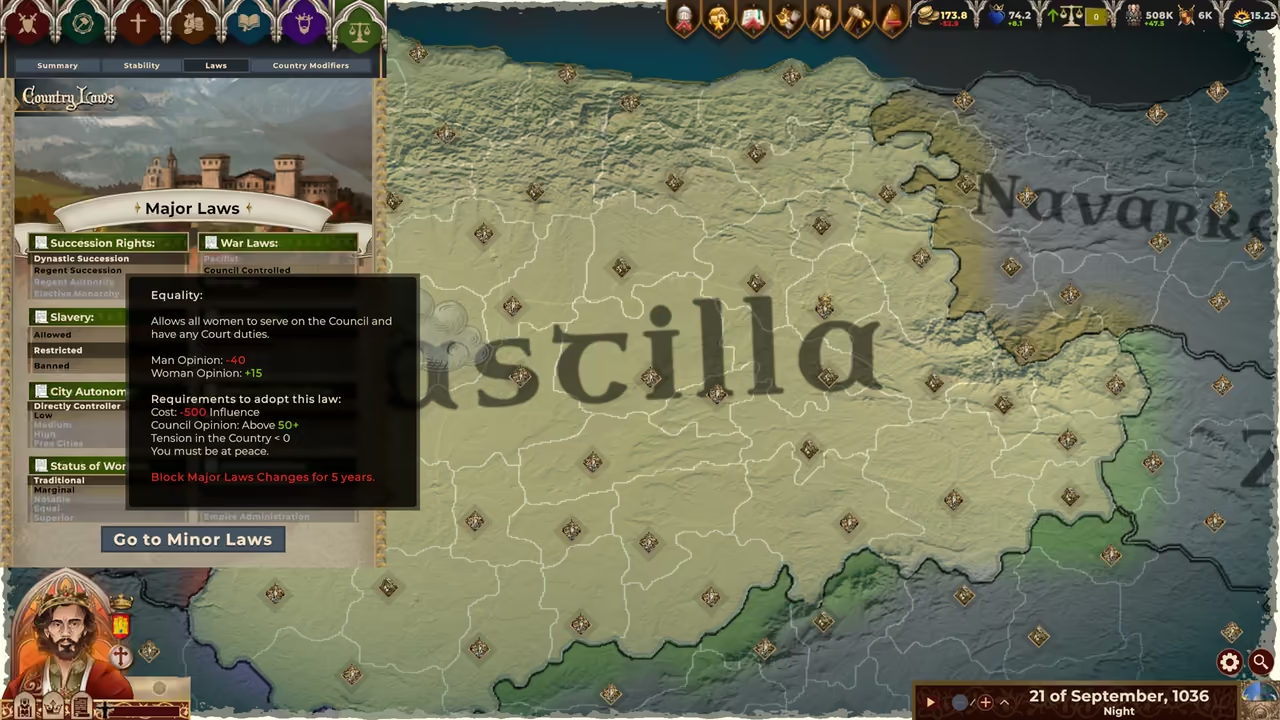
I had to look deep into policies to try to help fix the provinces. There are provincial choices, like the urban migration I mentioned earlier, feeding people half portions, and some others I could not figure out when to use. There are also minor and major laws that affects the country. The only difference is how much political power you need to issue them. Not many policies are implemented in the game, with just a placeholder showing, but there are some good bones there. For example, you can increase taxes if you have massive political pull, from the council members being happy to the stability of the country.
Appointing council members have benefits for your empire, depending on their profession they will add bonuses to a related field, also the more literate they are, the better the scientific progression of your people. This is the only thing where the Maghrawa starts stronger than Castile. While I did not have enough court to fill all the duties slot,s I could fill the council with 35 points worth of education, almost 10 more than the Christians. With it, I was able to hit the first scientific discoveries. Still, it took me almost half a century for them to take effect (!).
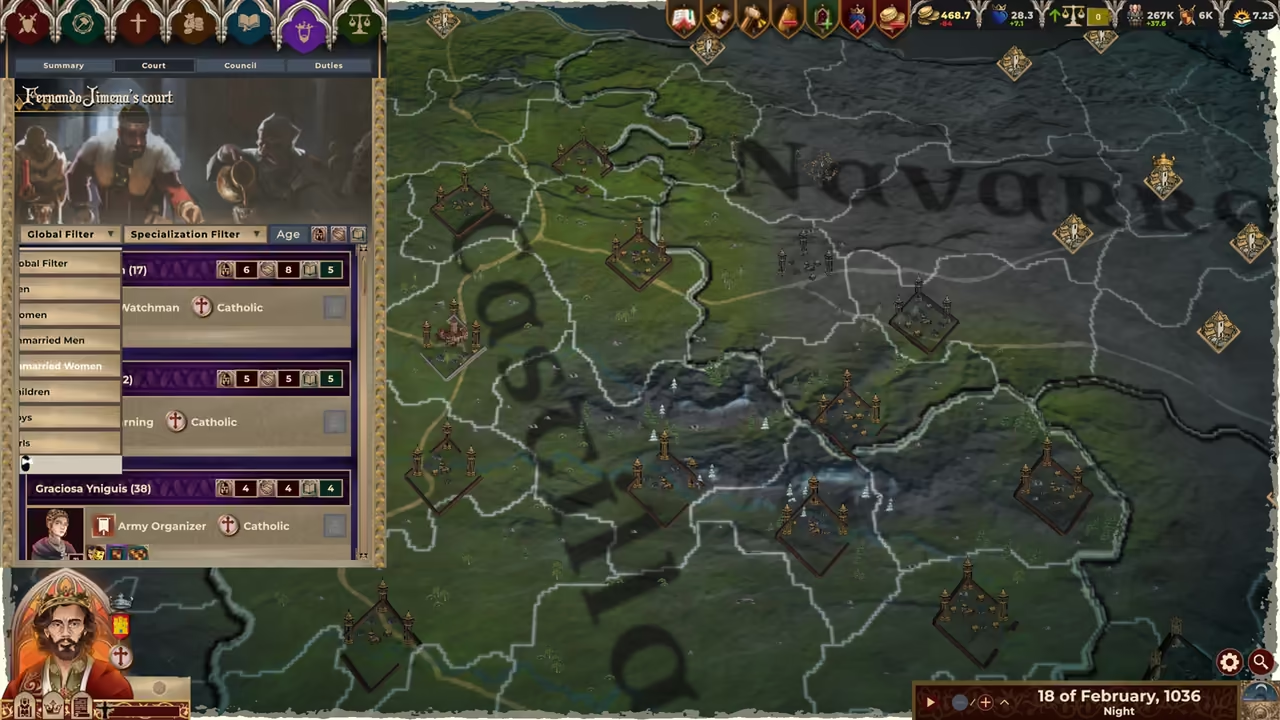
The court members have many professions, but it is not that useful except for a few bonuses they provide as council. Once in a while, they will ask you to pick one of 3 requests and fulfill it. Completing it increases your relationship with them and allows you to issue more laws, but it was also very buggy. It would not always work or complete for some weird reason.
You can appoint court members to several duties in your kingdom, but it is not clear what they do and what effects they cause. There were a bunch of roles, but no details. There are some roles related to war, like generals and champions. I could put them in leadership position in my army, but every time we ended in a phase of peace after a campaign, I would have to associate them to a different role again. There was no way to send people with diplomatic skills to deal with neighbors or appoint provinces’ governors.
Marriage was another problem. The menu itself is poorly designed. Sometimes I would have the button to send a proposal after picking a partner, sometimes it would be blank, and there was no reason showing why it was possible or not. Another issue was to find a suitable partner. I got a warning to marry my teenager heir, but going to his portrait and clicking on wedding, there was only a 60 year old person there that could be selected. But clicking on the portrait of other people and navigating around their relatives and diplomatic relationships, I saw plenty of people who were able to get married. I found the youngest daughter of the Badajoz’s leader was the same age as my heir, so I made the proposal since we were quite good friends, and the leader promptly accepted.
Eventually, the Badajoz’s heirs died all of a sudden. Not because of cunning or strategy. I did have some people in my court working as “spies”, but as I mentioned before, they are useless. I cannot send people to interfere either politically or with subterfuge. I also noticed my relationship with the old king was going down after that, no matter how many times I sent an army to help him when the Christians were attacking. On that note, I had plenty of agreements, including defensive and military ones, but they were never triggered when my friend was suffering a holy war. I had to click on his portrait and offer to join it.
Honestly, at this point I was just fast forwarding to see if I would take over Badajoz’ land once the king passed away. I was getting really disappointed by the lack of options, and the tediousness of trying to do things I was not able to achieve in the end. On top of that, several bugs halting my progress. To add insult to injury, even with every graphics settings set to minimum, the game was grinding to a halt, sufering from a very low framerate.
Once I managed to take over Badajoz, I moved my capital to Lisbon, and promptly uninstalled the game. But I will revisit it in a couple of years. Hopefully it will be more polished by then.
Crown of Hispania is on Steam as Early Access. It clearly needs more work.
Note: We received a key from the publisher for this review.