
CachyOS Is Now the Most Popular Desktop Distro on ProtonDB
It’s been a few months now since our last update and as you’ve seen from the headline, this is a huge milestone. CachyOS has taken over the 1st spot on ProtonDB for desktop distros, dethroning Arch Linux which was in the first spot, flawlessly since late 2021.
This kind of change has never happened before, and CachyOS’s progression is impressive, gaining share month after month without sign of stagnation. We had already seen signs that it would be cannibalizaing Arch in the end of 2025, but I seriously did not expect it to pass Arch so quickly. CachyOS gets recommended pretty much everywhere nowadays, so the word of mouth effect is working very well.
Before we take a look at the chart, the usual disclaimer:
- This may not be representative of all types of Linux users. I’m sure this is not what your AWS architect uses on EC2.
- This may not be completely representative of all Linux gamers either. But I’d wage this is actually a good predictor where the market is going to shift. We saw first that Manjaro was getting the boot here first, before going under pretty much everywhere.
- There may be some additional biases, due to whoever used ProtonDB.
- Flatpak is NOT a distro, but that’s what Steam reports when it’s running on Flatpak, and Flatpak being distro independent we report it as a separate environment, if that makes sense. Feel free to ignore it if you wish.
- Arch Linux is Arch Linux on the desktop. The Steam Deck’s OS is reported as HoloISO, not Arch Linux, so stop trying to claim that Arch is first because of the Steam Deck! This is mainly data reported from desktop PCs, so no, SteamOS is not a thing at the moment on such machines. This may change as Valve starts providing official support beyond the Steam Deck. There are Steam Deck-only reports on ProtonDB, but we don’t use them here in this chart.
- We have no relationship whatsoever with any the devs who develop the distros mentioned in the list.
You might want to click on the picture to enlarge it, because it’s small.
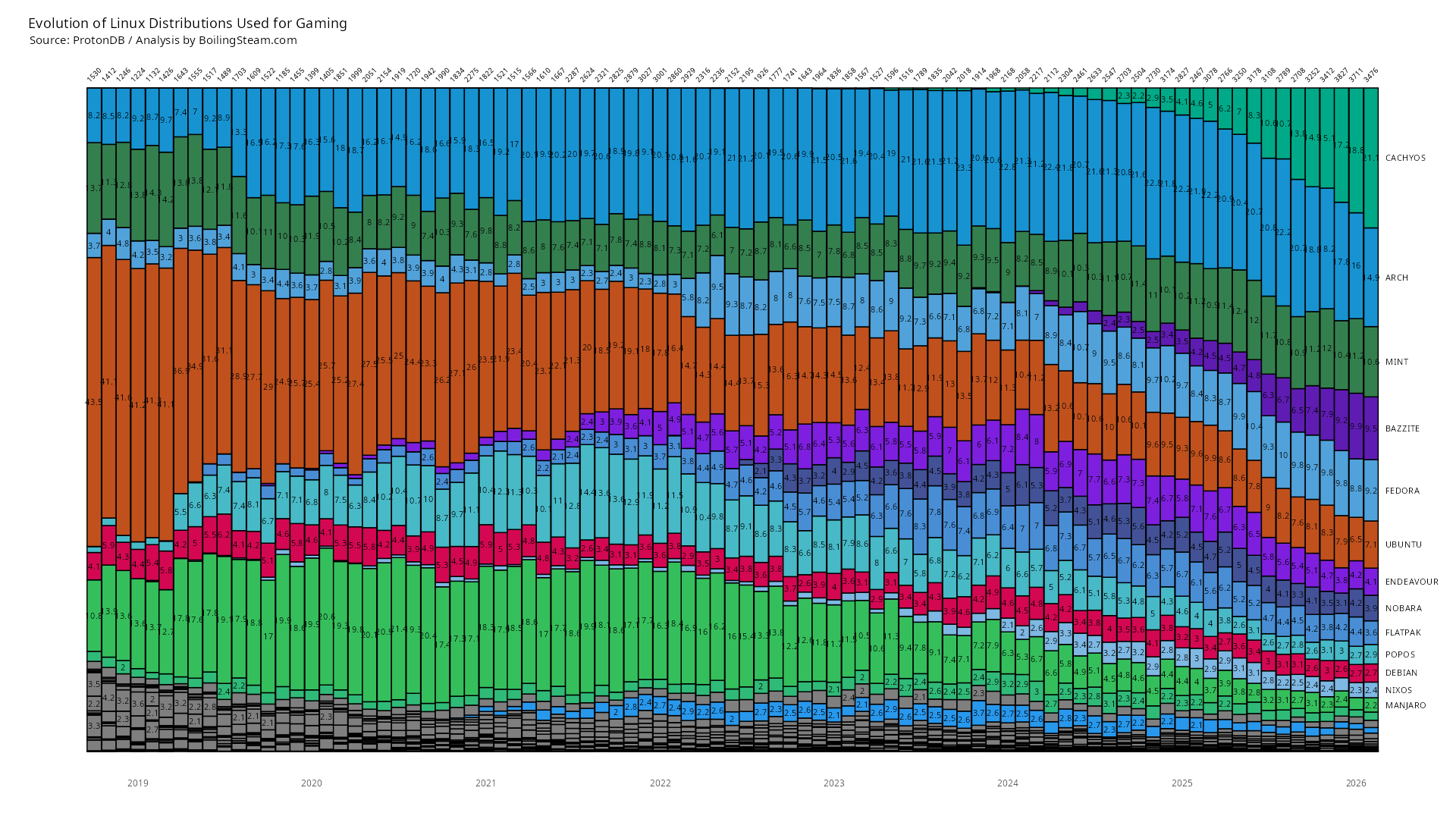
Now, what’s new with CachyOS in the past few months?
Recent CachyOS Developments
In the past few months (namely January and March 2026) they introduced a number of improvements in the distro, such as:
- Animated desktop previews in the installer (GIF/WebP) showing KDE Plasma, GNOME, Niri, and COSMIC as mini-videos
- Plasma Login Manager replaced SDDM as the default display manager (for desktop and handheld edition)
- Limine is now the default bootloader with automatic snapshots (systemd-boot still selectable), also true for handhelds
- NVIDIA module now includes
EnableAggressiveVblankoption for low-latency displays nouveau-fwinstalled for older NVIDIA cards (Kepler family) to enable VA-API support- FSR4 ML Frame Generation support added for RDNA4 and RDNA3 cards
- d7vk module support with DualSense haptic feedback patches
- Winboat integration for seamless Windows Docker VM experience (really cool project)
- Handheld Edition upgrades:
- Replaced
gamescope-session-pluswithgamescope-session-cachyos(forked from Valve’s gamescope-session) - Enables firmware updates for Steam Deck and Legion Go devices
- Replaced
- Linux-cachyos now publishes tagged releases in a dedicated repository (replacing single-patch workflow)
One of the strength of CachyOS is its ability to install a wide range of desktop environments with a user friendly interface. The ability to install COSMIC is one click, for example, reduces the friction to trying something else to almost nothing.
For gamers (which is the core audience of ProtonDB users), the focus on performance and the inclusion of tweaks for drivers, controllers and FSR4 is really helpful as well.
Last but not least, and this is VERY interesting, CachyOS does not intend to focus only on Desktop and handhelds - they are planning to release a server edition in 2026.
In addition to our ongoing PGO and AutoFDO optimizations, we are developing a specialized ‘Server’ Edition for NAS, workstations, and server environments. We intend to provide a verified image that hosting providers can easily deploy for their customers. This edition will ship with a hardened configuration, pre-tuned settings, and performance-optimized packages for web servers, databases and more!
If they can bring similar QOL improvements on the server-side of things they may have a very good chance to create a market for themselves there too.
Other News in the Ranking
While everyone was focusing on CachyOS, there’s been a stealthy move in the ranking with Bazzite quietly overtaking both Ubuntu and Fedora in usage share, and finding itself just behind Linux Mint right now. Bazzite has been subject to some internal controversy in the past few months, with one of the key developers, Antheas, being outed from the team for some reason. GPD was caught in the political firestorm at Bazzite since they were working with Antheas in good faith, unaware that the other developers were not on the same page (or not aware) of the ongoing work with GPD.

While Bazzite may be gaining ground, this set-back highlights some dysfunctions among the devs, how they communicate, and how they align. In his post, Antheas points out poor decision-making when it comes to releasing new functionality on the part of Kyle (the creator of Bazzite) which puts the credibility of the project in jeopardy:
So, he (Kyle) tends to push changes before they are fully ready so he can play with them. Examples are day one Fedora releases regardless of whether it works properly (although we got good at that), yanking X11 in early 2024 as Chris Titus (first big youtuber) was reviewing Bazzite, breaking a lot of his software and causing him to ragequit the review, introducing Bazaar too early while it had memory issues and crashed on low end hardware, switching to iwd the day Phoronix announced there are rumors Intel stopped maintainance and breaking enterprise WiFi and WiFi on a lot of Intel devices, using Ptyxis as the default terminal (decent software, but Konsole is fine), bundling the Steam client plus problematic codecs so Bazzite cannot ship on hardware, and putting an assortment of unnecessary packages that we then have to maintain (8 Gnome extensions, etc).
I would certainly not rely only on just one side of the story, but if this is even remotely factual, this is seriously a concern for all users of Bazzite out there.
But enough about Bazzite. Pop_OS! had launched its 24.04 LTS version (2 years late) back in December 2025 with the COSMIC desktop, and it does not seem to have had any impact on its usage share. COSMIC has some interesting ideas, but I wonder if there are not more COSMIC users now on other distros than the ones on Pop_OS! itself.
Manjaro is at the end of its lifecycle, flirting with the lower 2% of usage share on ProtonDB. Sometimes I hear people recommending Manjaro here and there - and it’s probably because their Linux distro knowledge is outdated. Nobody should be recommending Manjaro in 2026, it’s worse than all of the other Arch-based distros available.
Distro Popularity by Base
Another way to look at this data is to aggregate the distro by origin instead of individual brands.
So we get (focusing only on the major distros, which accounts for most of the usage share anyway):
- Arch-based: 21.1 + 14.9 + 4.1 + 2.2 = 42.3 %
- Debian-based: 10.6 + 7.1 + 2.7 + 2.9 = 23.3 %
- Fedora-based: 9.5 + 9.2 + 3.9 = 22.6 %
And we can confirm we are really in an Arch-based domination when it comes to Linux gaming.
One year ago, in February 2025, this was the situation:
- Arch-based: 37.6 %
- Debian-based: 27.8 %
- Fedora-based: 17.1 %
While there has been some cannibalization of Arch from CachyOS, on the whole this is net-positive as the footprint of Arch-based distros has grown very quickly in the past year. This also confirms that Debian-based distros are losing ground and Fedora-based systems are gaining more popularity (fairly obvious if you follow the distro news).
For now, it seems like CachyOS is bound to keep gaining traction, even after securing the first spot.